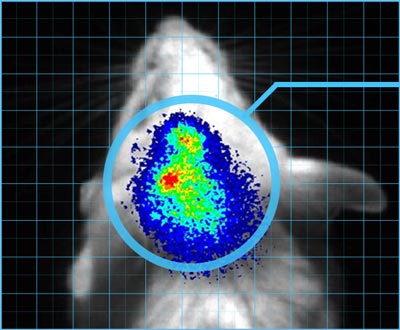
 BioLume bioluminescent enzymes have broad applications in medical imaging including anatomic, vascular and molecular imaging. Optical (bioluminescent) imaging represents a shift in medical imaging from the visualization of anatomy and physiology to the study of metabolic and physiological processes, such as cancers, at the cellular level, often in real time. By tagging molecules with our natural bioluminescent enzymes, it is possible to track the progression of disease and evaluate the efficacy of a therapy. It is also possible to illuminate anatomical features such as tumors, ducts, and arteries. Once the bioluminescent light is produced on the molecular level, a visible light camera is used to acquire images through the tissue. These cameras are commercially available today and are less expensive than X-ray, CT, MRI, Nuclear, ultrasound, and PET equipment. BLI has minimal background activity, and is very sensitive and quantitative.
About Medical Imaging
BioLume bioluminescent enzymes have broad applications in medical imaging including anatomic, vascular and molecular imaging. Optical (bioluminescent) imaging represents a shift in medical imaging from the visualization of anatomy and physiology to the study of metabolic and physiological processes, such as cancers, at the cellular level, often in real time. By tagging molecules with our natural bioluminescent enzymes, it is possible to track the progression of disease and evaluate the efficacy of a therapy. It is also possible to illuminate anatomical features such as tumors, ducts, and arteries. Once the bioluminescent light is produced on the molecular level, a visible light camera is used to acquire images through the tissue. These cameras are commercially available today and are less expensive than X-ray, CT, MRI, Nuclear, ultrasound, and PET equipment. BLI has minimal background activity, and is very sensitive and quantitative.Comment
You must be logged in to post a comment.