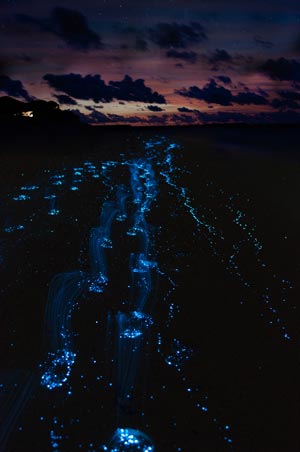
 Bioluminescence is light produced by a chemical reaction within a living organism. Usually two substances and Oxygen are required. The substance that produces the light is generically called luciferin, and the substance that drives or catalyzes the reaction is called lucerifase. The chemical reaction from combining these substances is very efficient, producing 98% of its energy as light (glow) and only 2% as heat. One photon of light is produced for each molecule of luciferin consumed. Luciferases perform this reaction several hundred times per second, and will continue until all the luciferin is consumed.
The specific luciferin BioLume uses is called Coelenterazine, a word derived from Coelenterates, a class of marine invertebrates that includes jellyfish, sea anemones, and corals. Coelenterazine is the most widespread luciferin molecule found in nature.It is a very potent, natural anti-oxidant. All of the marine organisms that emit light use different luciferases but most use the same luciferin, Coelenterazine.
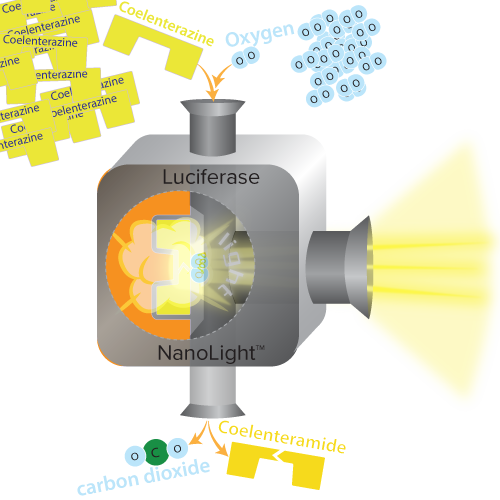 BioLume has a number of proprietary luciferases in its portfolio. These include Renilla and Gaussia. BioLume also has proprietary green fluorescent proteins that can be combined with luciferases to create a spectrum of glowing colors. The base color is blue.
Another kind of luciferase is called a “photoprotein” where luciferin and luciferase are bound together. This molecule can be triggered to produce light when a particular type of ion is added to the system (usually Calcium). Photoproteins emit a flash of very bright light for a fraction of a second for very interesting effects like twinkling stars in food and beverages.
Bioluminescence is not the same as “fluorescence”. In fluorescence, energy from a source of light is absorbed and re-emitted as another photon. In bioluminescence the excitation energy is supplied by a chemical reaction rather than from a source of light.